
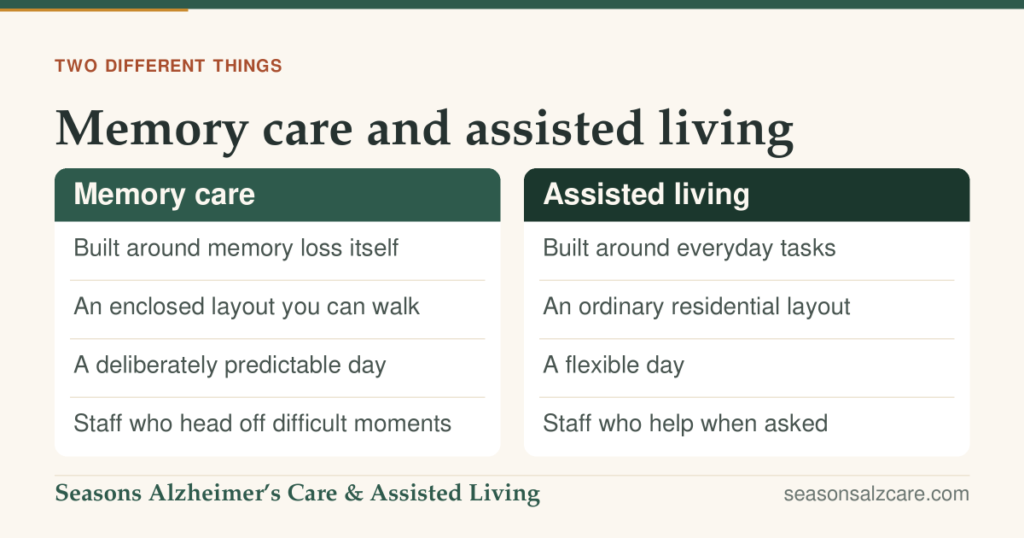
Memory care is residential support built around one thing: helping a person who is living with Alzheimer’s or another form of dementia get through an ordinary day safely, calmly and with their dignity intact. In San Antonio, that usually means a small community with a safe, enclosed layout, where the routine, the building and the staffing are all arranged around memory loss rather than added on afterwards.
Families rarely start looking because of one dramatic moment. It is usually an accumulation — the stove left on, the same question asked six times before lunch, a night spent awake and disoriented, a shower that has become a fight. Memory care exists for the point at which the day has more of those moments than a family can absorb at home, and it is a support decision rather than a medical one.
What to look at, in practical terms
A building designed around the routine, not the other way round
Look at how the space actually works on an ordinary Tuesday. Can a resident walk a loop without meeting a locked door that frustrates them? Is the dining room quiet enough that someone with a short attention span can finish a meal? Are bathrooms visible from the bed? Small architectural decisions decide how often a person becomes anxious, and anxiety is what most family visits are really about.
Staff who know the person, not just the shift
Ask how long the people on the floor have worked there and how a new resident’s history is passed on. A team that knows someone was a school teacher, hates crowds and settles with music from the 1950s can prevent a difficult afternoon that a stranger can only manage after it starts. Continuity is the single most useful thing to ask about, and it is easy to check: talk to whoever is in the room, not only to whoever gave you the tour.
A day with shape to it
Watch what is happening when you arrive unannounced. Residents who are dressed, occupied and among other people are the sign of a working routine; a lounge where everyone is asleep in front of a television at eleven in the morning is a sign of the opposite. Activity does not have to be elaborate — folding laundry, walking outside, helping in the kitchen and listening to familiar music all do more good than a printed calendar.
Honest conversation about what happens as needs change
Ask directly what would make a move necessary later, and what the community does when someone needs more help than they did at admission. A straight answer — including “we would tell you, and here is when” — is worth far more than a reassuring one. Families are rarely upset by limits; they are upset by finding out about them late.
Questions worth asking out loud
- Who will be with my parent at three in the morning, and how long have they worked here?
- What does a normal weekday look like from waking up to going to bed?
- How do you help someone who is upset, without simply moving them somewhere quieter?
- What would make you tell us this is no longer the right place, and how early would we hear it?
- May we come back at a different time of day, unannounced?
How Seasons approaches this in San Antonio
A small community of 16. With only sixteen residents, people develop real relationships with each other and the staff — never an institution. 24/7/365 trained care. Friendly, well-trained staff are on hand every hour of every day to meet each resident’s needs with dignity. Wholesome home-cooked meals. Our director’s background in nutrition means every resident enjoys home-cooked meals that meet their needs.
Seasons Alzheimer’s Care & Assisted Living is an owner-led memory care provider in San Antonio, Texas, founded by Mona Talukdar and operating residential memory care communities since 2013. and the same team answers the phone that you will meet in the house.
Where to read further
- the Alzheimer’s Association — what residential care options are and how they differ from one another.
- MedlinePlus, from the US National Institutes of Health — a plain-language overview of dementia.
Come and see for yourself
The only way to know whether a house suits your family is to stand in it. You can arrange a visit at a time that suits you, or call us on (210) 584-4238. Come at an ordinary hour, meet whoever is working, and ask us anything on the list above.
Seasons provides residential support and companionship, not clinical services. Anything a physician should decide belongs with your family’s own doctor, and the public-health sources linked above are the authority on their own subjects.